
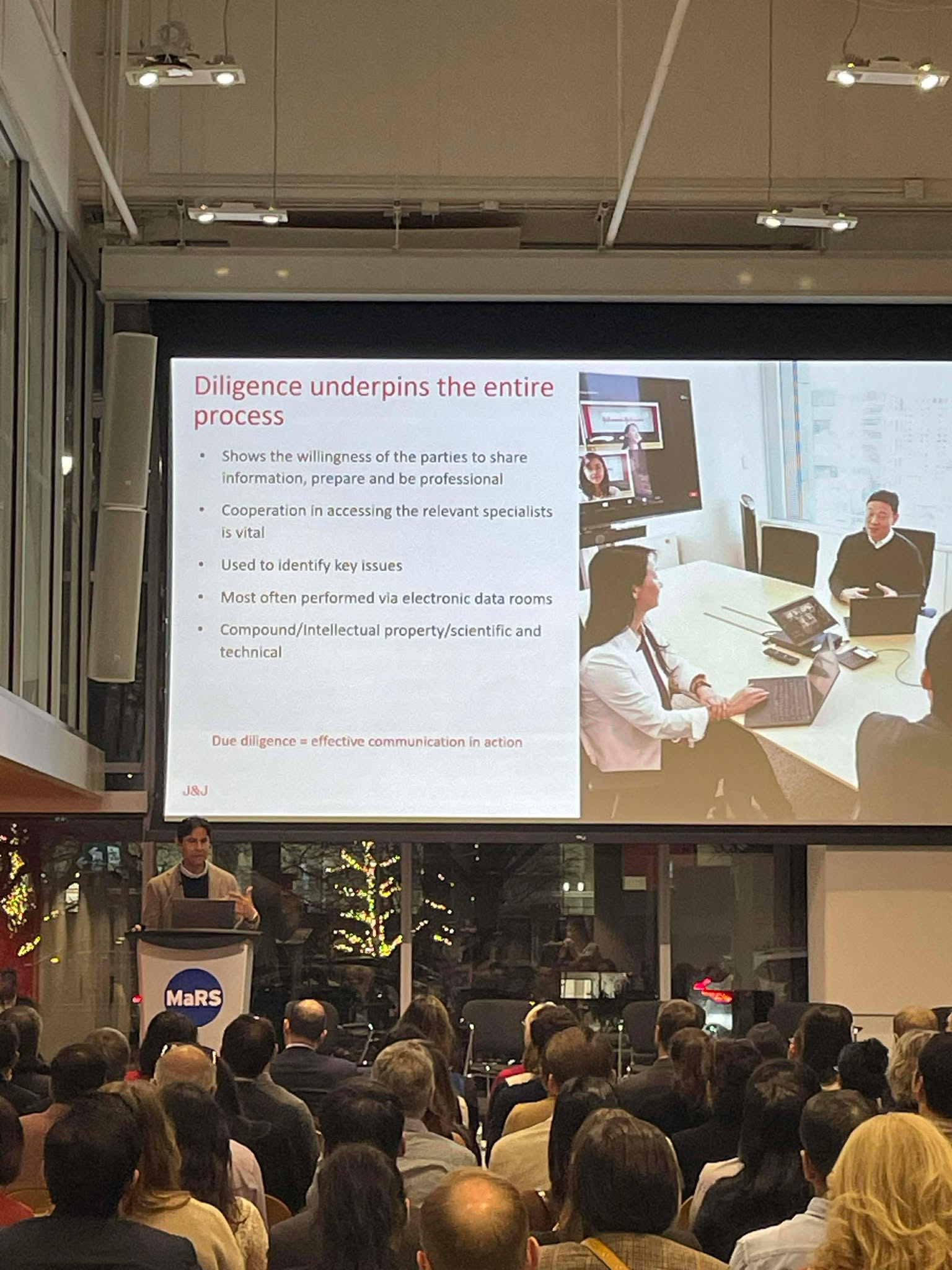
Most people think biotech deals are decided in negotiation rooms. They picture valuation models, lawyers, and last minute tradeoffs over price and control. Sitting in a room with dealmakers at MaRS, it became clear that this picture is largely wrong. By the time negotiations begin, most outcomes are already constrained by decisions made far earlier, often quietly and without much fanfare.
What determines whether a partnership moves forward is rarely the science alone. Everyone in the room understands the science. What separates momentum from silence is how uncertainty is handled before anyone is forced to take a position.
Diligence is how trust is tested
Diligence is often framed as a process. In reality, it is a stress test. It exposes how teams behave when clarity is incomplete and risk is unavoidable. The quality of diligence is not measured by the size of the data room, but by how selectively information is shared, how directly limitations are acknowledged, and how quickly the right experts are brought into the conversation. Strong diligence reduces internal friction for the potential partner. Weak diligence creates work, doubt, and hesitation. Once that doubt enters the system, it is difficult to remove.
What dealmakers are really assessing is not just the asset, but the people behind it. Can they be trusted when timelines slip. Can they communicate tradeoffs without defensiveness. Can they support internal decision making rather than complicate it.
Alignment matters more than enthusiasm
Many promising partnerships stall not because enthusiasm is lacking, but because alignment never fully forms. Business teams look for clarity. Who owns the relationship. What the next decision point is. How risk is staged over time. Scientific teams look for credibility. Whether expectations are realistic. Whether ambition is grounded in feasibility. Whether the partner actually understands the constraints of development.
When these perspectives drift, progress slows. Even strong data struggles to overcome misalignment. Deals rarely fail loudly. They fade.
Traction comes from making decisions easier
One of the clearest insights from the conversation was that traction is not created by saying more. It is created by making decisions easier for the other side. That means leading with what actually matters. Framing data around the questions decision makers need to answer internally. Acknowledging what is unknown rather than trying to outpace it with optimism.
The strongest pitches are not comprehensive. They are precise. They create confidence not by removing uncertainty, but by showing that uncertainty is understood and managed.
Contracts reflect where risk sits
By the time contracts enter the discussion, the tone has already shifted. Structure becomes the language of risk. Exclusivity, options, field definitions, and development rights are not legal abstractions. They are mechanisms for controlling exposure while preserving upside. Price matters, but structure determines how a partnership survives pressure.
Well structured deals absorb uncertainty. Poorly structured ones amplify it.
Valuation is contextual, not absolute
Valuation often appears objective, but it is deeply contextual. The same program can be strategically essential to one company and marginal to another. Portfolio gaps, competitive timing, internal capabilities, and market access realities all influence how value is perceived. Numbers provide justification, not truth.
This is why arguments over valuation rarely resolve deals. Alignment does.
The real negotiation happens internally
Perhaps the most revealing insight was how much effort goes into internal consensus before any external agreement is reached. Deals fail internally far more often than they fail across the table. Teams must align on strategic intent, risk tolerance, resource allocation, and opportunity cost. External partners are often only seeing the final layer of a much longer internal process.
The most effective dealmakers understand this. They do not try to win negotiations. They help the other side succeed internally.
By the time a biotech partnership is announced, the most important work has already happened. Not in boardrooms or press releases, but in early conversations where trust is tested, alignment is built, and uncertainty is given structure. That is where deals are really made.


Leave a Reply